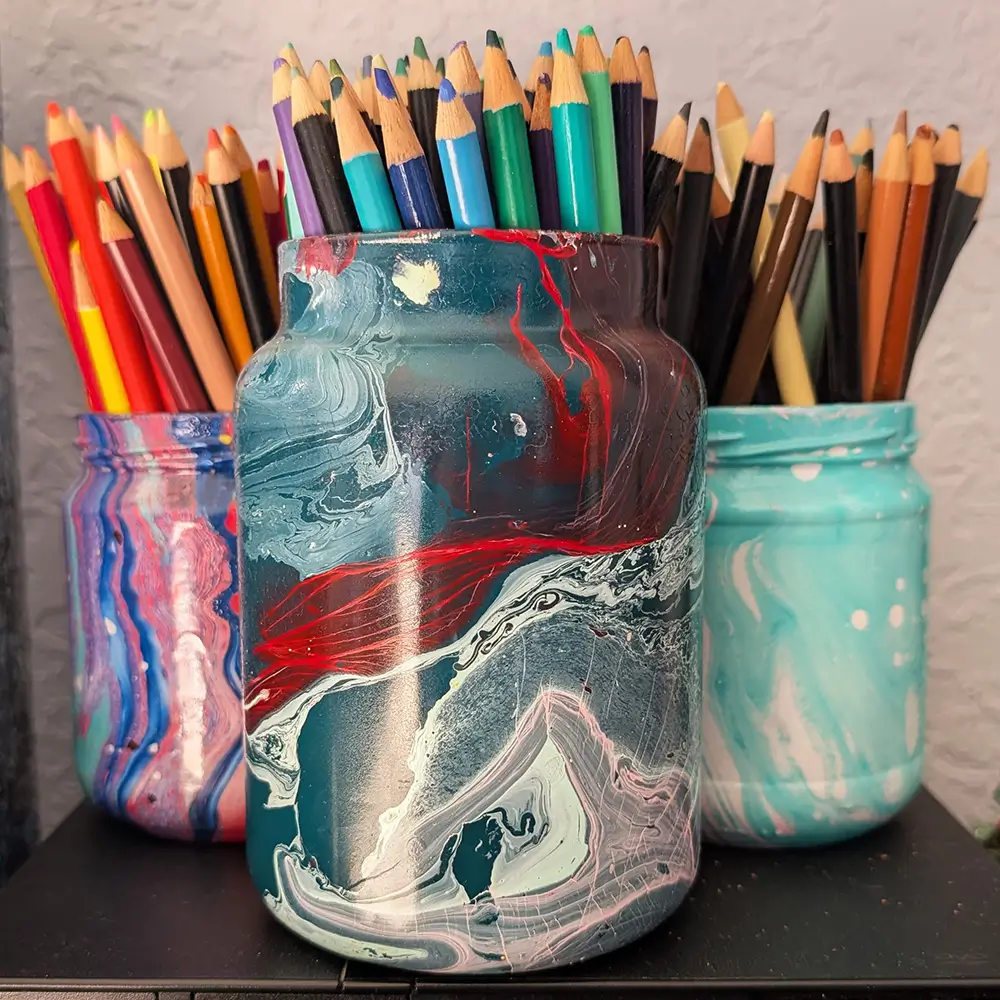
For as long as I can remember, I’ve looked for objects that are both functional and beautiful. I’ve always found it hard to justify a purchase that would just sit there and look pretty. This became especially important when I moved into my RV—limited space and storage means functionality suddenly becomes everything. That’s especially true when your space is overflowing with art supplies and half-finished projects.
The CD Mosaic
Does anyone remember burning music onto CDs, or am I just getting old? Either way, I had a stack of burnable CDs that had traveled with me all the way from the last century (old!), and I decided it was time to finally find a use for them.
This all happened during quarantine, when I was stuck at home and bored out of my mind. Idle mind, am I right? With too much time and not enough distractions, I started looking around at what I already had—and those CDs kept catching my eye.
They were scratched, outdated, and not something I could really donate—but I couldn’t bring myself to throw them away either.
At the same time, my RV kitchen felt painfully boring. White countertops, a blank wall, and nothing about it that felt like me. So instead of buying something new to decorate the space, I decided to work with what I already had.
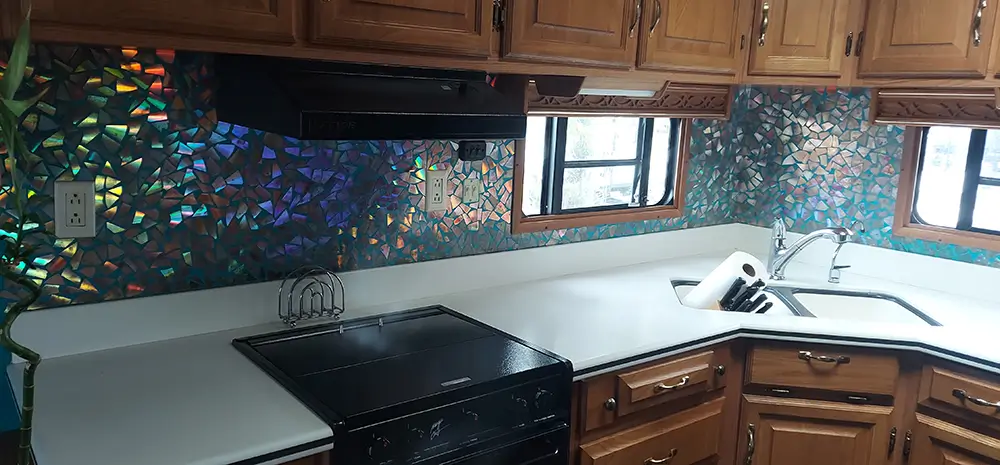
I cut the CDs into pieces and turned them into a mosaic backsplash.
When the light from the skylight hit it, the colors scattered across the kitchen in fractured rainbows—moving with the time of day, changing constantly. What had started as a way to avoid a dull wall became one of my favorite spaces in the entire RV. It wasn’t just decoration; it was transformation.
That project shifted how I thought about reuse.
Learning to See Beyond
Somewhere between cutting up old CDs and rearranging my kitchen, I realized something had shifted in how I looked at everyday objects.
Instead of asking, What is this for? I started asking, What could this become?
That change in perspective makes a surprising difference. When you stop treating objects as single-purpose and start seeing them as materials, they become creatively freeing. A jar doesn’t have to be a jar. A cup doesn’t have to be a cup. A container doesn’t have to stay in the room it was originally meant for.
For me, it’s less about having a specific plan and more about paying attention. Noticing shape. Noticing size. Noticing how light hits a surface, how something feels in your hand, how it might look filled with something completely different from what it once held.
I don’t usually start with a finished idea. I start with a question.
Could this hold something useful?
Could this be part of a display instead of hidden in a drawer?
Could this make a space feel more personal?
That’s how reuse stopped being about practicality and started being about imagination. It became less about saving things from the trash and more about collaborating with what already exists.
A Salsa Jar
That shift in perspective led me back to the items discarded around the home. I’d seen beautiful projects online made from tin cans and plastic bottles, but while they were visually interesting, they weren’t always functional enough for me. Then one day, as I was getting rid of yet another salsa jar (something I go through a lot), I had an idea.
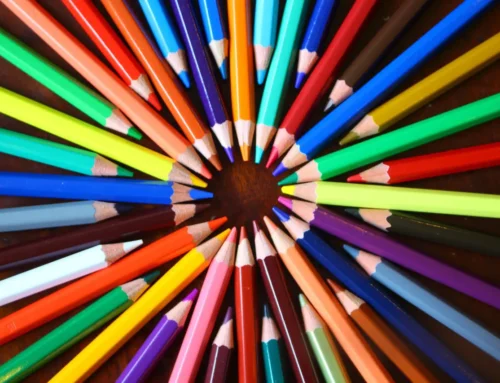
There was a small shelf above a built-in desk at the edge of my kitchen—RV ingenuity at its best—and I had turned the desk area into a little craft section. It was covered in colored pencils, paintbrushes, and other supplies, while the shelf held a few figurines I’d carried with me since childhood. Since the figurines weren’t really functional to the space, I moved them and tested the fit of a jar on that tiny shelf.
It fit.
That was honestly the moment everything started to come together.
From Experiment to Everyday Use
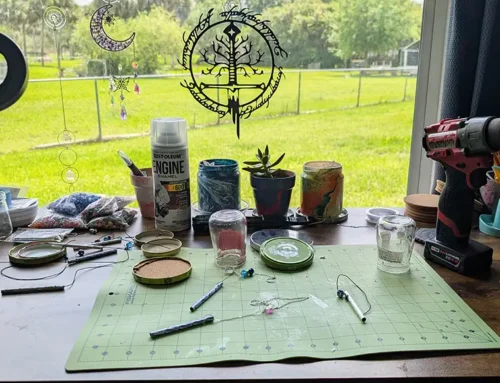
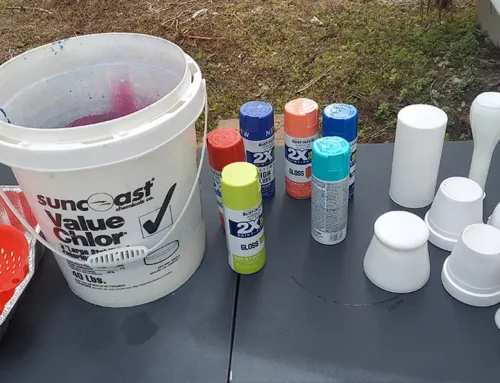
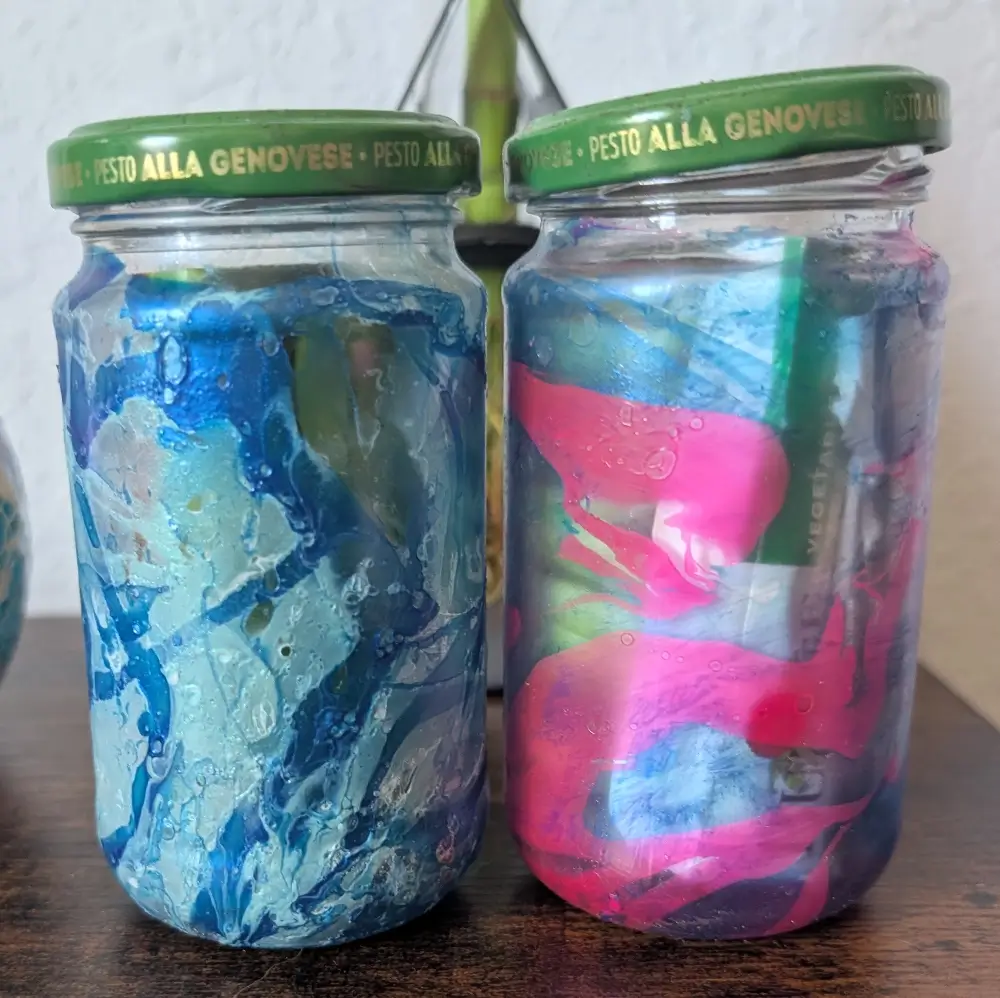
The jars stayed plain for a while until I stumbled across a video on Pinterest of someone using nail polish on water. Nail polish became my first experiment, and I’ve kept some of those original tests to this day. They can’t hold much, but I use them for seed packets to keep pests out. While nail polish worked, it didn’t give me the color range I wanted, so I went to the store to try what I thought might be the next best thing: spray paint.
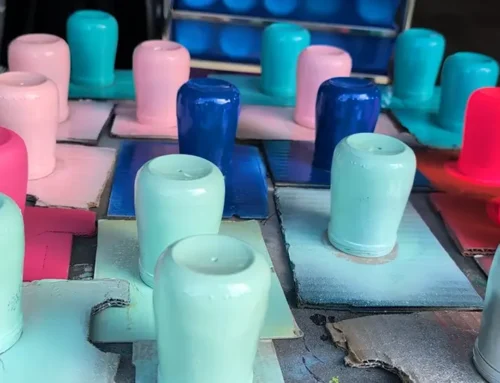
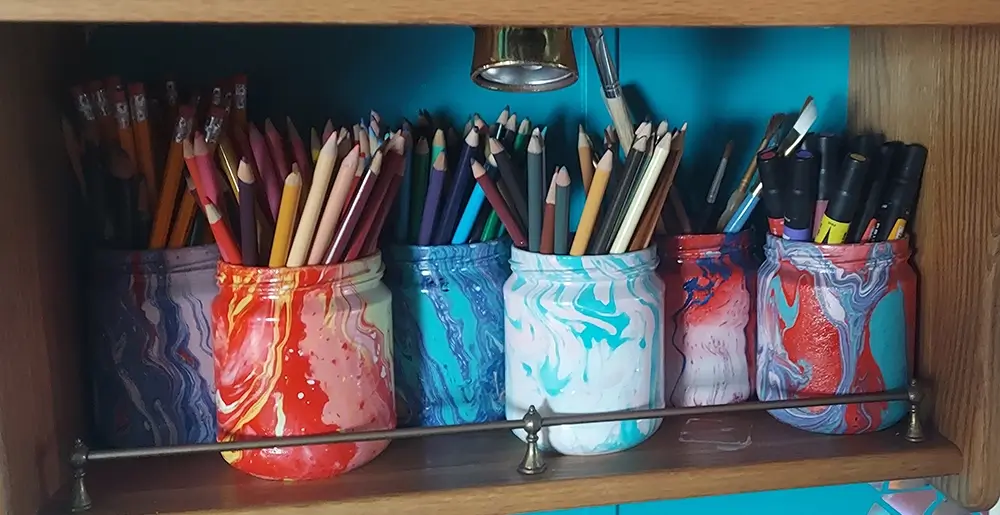
It took some trial and error to find the right kinds to use, but eventually I got there. That original shelf of plain glass jars became a colorful and functional display that still lives in my space today.
From there, it became a hunt around the house. Every time I finished a different jar, I’d look for a purpose for it. Hair bands loose around the house for the cat to steal? Into a bouillon cube jar. Bracelets tangled with necklaces? A candle jar became bracelet storage. Makeup everywhere? I’d find the jar it fit into.
The Philosophy Behind It All
That’s when it really clicked for me: objects can be both functional and beautiful. They don’t have to be new, and they don’t have to serve their original purpose.
Reduce, reuse, recycle is something I stand by—but it doesn’t have to be plain or ugly while you do it. There is beauty and potential in everyday objects, and learning to see both can change not just your space, but the way you live in it.
For as long as I can remember, I’ve looked for objects that are both functional and beautiful. I’ve always found it hard to justify a purchase that would just sit there and look pretty. This became especially important when I moved into my RV—limited space and storage means functionality suddenly becomes everything. That’s especially true when your space is overflowing with art supplies and half-finished projects.
The CD Mosaic
Does anyone remember burning music onto CDs, or am I just getting old? Either way, I had a stack of burnable CDs that had traveled with me all the way from the last century (old!), and I decided it was time to finally find a use for them.
This all happened during quarantine, when I was stuck at home and bored out of my mind. Idle mind, am I right? With too much time and not enough distractions, I started looking around at what I already had—and those CDs kept catching my eye.
They were scratched, outdated, and not something I could really donate—but I couldn’t bring myself to throw them away either.
At the same time, my RV kitchen felt painfully boring. White countertops, a blank wall, and nothing about it that felt like me. So instead of buying something new to decorate the space, I decided to work with what I already had.
I cut the CDs into pieces and turned them into a mosaic backsplash.
When the light from the skylight hit it, the colors scattered across the kitchen in fractured rainbows—moving with the time of day, changing constantly. What had started as a way to avoid a dull wall became one of my favorite spaces in the entire RV. It wasn’t just decoration; it was transformation.
That project shifted how I thought about reuse.
Learning to See Beyond
Somewhere between cutting up old CDs and rearranging my kitchen, I realized something had shifted in how I looked at everyday objects.
Instead of asking, What is this for? I started asking, What could this become?
That change in perspective makes a surprising difference. When you stop treating objects as single-purpose and start seeing them as materials, they become creatively freeing. A jar doesn’t have to be a jar. A cup doesn’t have to be a cup. A container doesn’t have to stay in the room it was originally meant for.
For me, it’s less about having a specific plan and more about paying attention. Noticing shape. Noticing size. Noticing how light hits a surface, how something feels in your hand, how it might look filled with something completely different from what it once held.
I don’t usually start with a finished idea. I start with a question.
Could this hold something useful?
Could this be part of a display instead of hidden in a drawer?
Could this make a space feel more personal?
That’s how reuse stopped being about practicality and started being about imagination. It became less about saving things from the trash and more about collaborating with what already exists.
A Salsa Jar
That shift in perspective led me back to the items discarded around the home. I’d seen beautiful projects online made from tin cans and plastic bottles, but while they were visually interesting, they weren’t always functional enough for me. Then one day, as I was getting rid of yet another salsa jar (something I go through a lot), I had an idea.
There was a small shelf above a built-in desk at the edge of my kitchen—RV ingenuity at its best—and I had turned the desk area into a little craft section. It was covered in colored pencils, paintbrushes, and other supplies, while the shelf held a few figurines I’d carried with me since childhood. Since the figurines weren’t really functional to the space, I moved them and tested the fit of a jar on that tiny shelf.
It fit.
That was honestly the moment everything started to come together.
From Experiment to Everyday Use
The jars stayed plain for a while until I stumbled across a video on Pinterest of someone using nail polish on water. Nail polish became my first experiment, and I’ve kept some of those original tests to this day. They can’t hold much, but I use them for seed packets to keep pests out. While nail polish worked, it didn’t give me the color range I wanted, so I went to the store to try what I thought might be the next best thing: spray paint.
It took some trial and error to find the right kinds to use, but eventually I got there. That original shelf of plain glass jars became a colorful and functional display that still lives in my space today.
From there, it became a hunt around the house. Every time I finished a different jar, I’d look for a purpose for it. Hair bands loose around the house for the cat to steal? Into a bouillon cube jar. Bracelets tangled with necklaces? A candle jar became bracelet storage. Makeup everywhere? I’d find the jar it fit into.
The Philosophy Behind It All
That’s when it really clicked for me: objects can be both functional and beautiful. They don’t have to be new, and they don’t have to serve their original purpose.
Reduce, reuse, recycle is something I stand by—but it doesn’t have to be plain or ugly while you do it. There is beauty and potential in everyday objects, and learning to see both can change not just your space, but the way you live in it.
Leave A Comment Cancel reply
Inside the Cauldron
No spam. Just art, ideas, and experimentation.
Sign up for the Prismatic Cauldron newsletter for blog updates, new artwork, behind-the-scenes process, and the occasional creative rant—delivered straight to your inbox.